
 Get the App
What is Rafli
Rafli is an ancient system of geomantic divination that reached the Slavs from the East. For many centuries it was used to answer an important question, make sense of a difficult situation, or see the likely course of events.
Unlike Tarot, runes, or other divinatory systems, Rafli does not use cards, stones, or special objects. At its core are sixteen geomantic figures (izraz), built by a fixed algorithm from randomly obtained data. Twelve of these figures are then placed in special “houses,” each governing a sphere of life. It is the combination of figures and their positions that yields an interpretation.
The chief distinction of Rafli is that the whole reading is one logical system: every figure is linked to the others and derived in sequence from the four originals. Each reading is therefore unique and forms a coherent picture, not a set of independent symbols.
History of Rafli
The history of Rafli begins more than a thousand years ago. Its foundation was Arabic geomancy — the art of reading from chance marks in the sand. The very word geomancy comes from the Greek geo (“earth”) and manteia (“divination”), while the Arabic name of the art — ʿilm al-raml — means “the science of sand.”
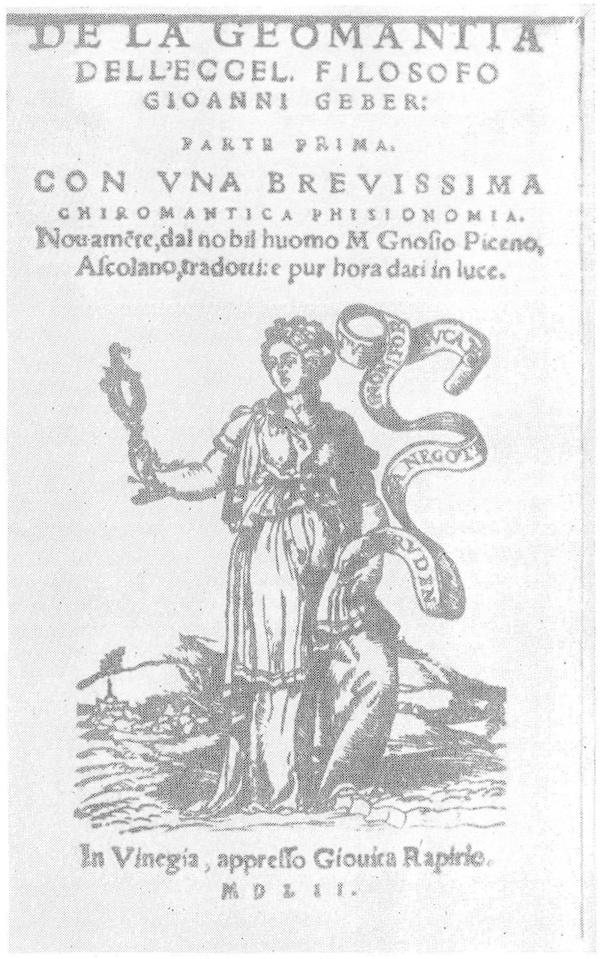
In time geomancy spread far beyond the Arabic world. Through Byzantium and Constantinople it reached Eastern Europe, where local scribes adapted it. Scholars note that some Old Russian manuscripts even preserved the Eastern habit of writing figures from right to left — a sign of the system’s origin.
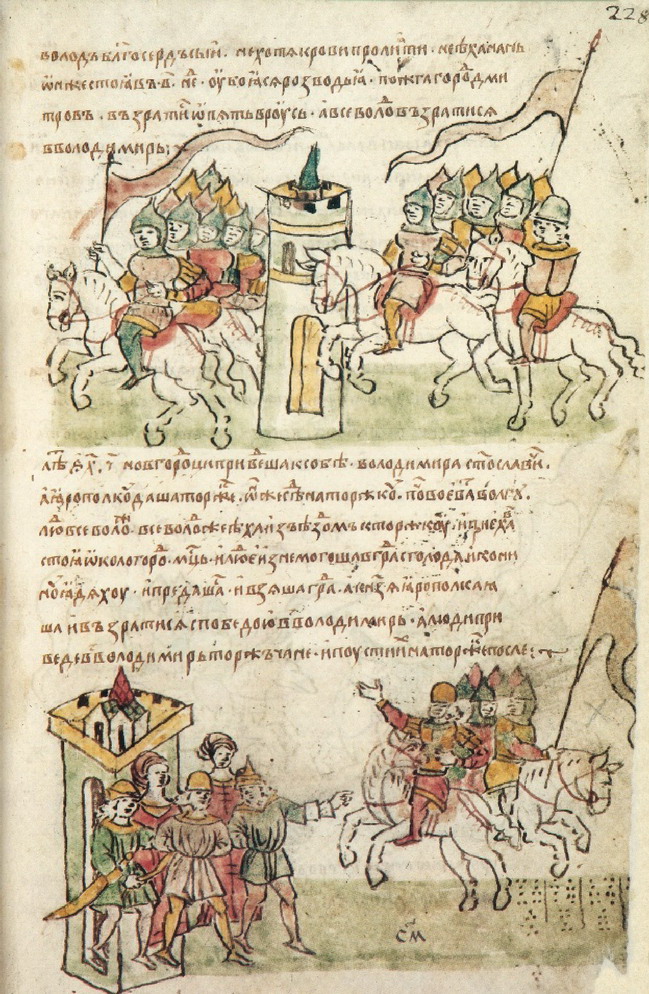
In Rus, Rafli appeared no later than the sixteenth century. They existed as handwritten books describing the figures, the rules for building a chart, and their meanings. Although the Church numbered such books among the “forbidden” and discouraged their spread, the manuscripts continued to be copied, and the system has survived to our day with little change.
Rafli, Ramli, and geomancy
The same divination system has been known under many names in different languages and regions. In Arabic it was ʿilm al-raml (“science of sand”); in Greek-derived usage — geomancy; in East Africa and Hausa communities often Ramli; in Old Russian and Slavic manuscripts — Rafli. Regional lineages differ in detail, yet they share the core of sixteen figures built from points.
The Rafli app implements the late medieval European form of this tradition — the chart with twelve houses, Witnesses, and Judges as preserved in Latin and Slavic manuscripts — rather than later regional variants.
What is Rafli used for?
People traditionally turned to Rafli when a hard decision was needed or when events had to be understood. A reading could help see the situation from a new angle, notice hidden circumstances, or grasp the tendencies of the present moment.
Rafli is most often used for questions about:
- relationships and love;
- family;
- work and career;
- finances;
- travel;
- finding lost things;
- choosing among several options;
- a general forecast of how a situation may unfold.
It is important to remember that Rafli does not issue ready-made commands and does not replace a person’s own decision. Its task is to show a symbolic picture of what is happening and to help notice what might otherwise remain unseen.
How is a reading built?
Originally the diviner unconsciously marked sixteen rows of dots on sand or paper. Then each row was judged only as odd or even. From these rows the four first figures — the Mothers — were built, and from them, by strict rules, all the rest were derived. That is the method described in the old manuscripts.
Our app performs these calculations automatically while keeping the historical algorithm. You no longer need to count dots by hand: choose a house (sphere of life), ask your question, and draw sixteen rows of dots — the system builds the full chart.
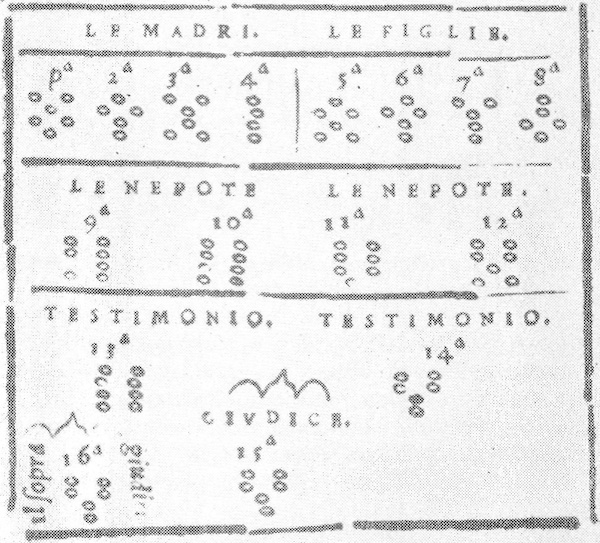
The result is sixteen geomantic figures. The first twelve are placed in the twelve houses; figures 13–16 are the Witnesses and Judges, which summarize the reading. Each house governs a sphere of life. What matters is not only each figure on its own, but also its place in the chart and its combination with the others.
Foundations of the system
Rafli rests on sixteen geomantic figures (izraz). Each has its own name and symbolic meaning and is traditionally linked to an element, a planet, and a zodiac sign. The combination of these figures is the language in which the chart “speaks.”
No less important are the twelve houses — symbolic fields that hold the first twelve figures. They show which sphere of life the answer concerns and which circumstances weigh most on the situation.
A full description of all sixteen figures and twelve houses is available in the corresponding sections of the app.
Why Rafli still matters
Over the centuries Rafli has scarcely changed. The simplicity of the chart, the inner logic of the system, and a rich historical tradition have let it outlast shifts of age and culture.
Today Rafli remains one of the most intriguing forms of geomancy. It joins Eastern tradition, Byzantine heritage, and Slavic book culture, preserving the same principle of chart-building used many centuries ago. That is why Rafli is of interest not only as a method of divination, but as a living piece of cultural history.
The Rafli calculation algorithm
At first glance a Rafli chart may look like a random set of symbols, yet it is built by strict rules. All sixteen figures are computed from four originals, so every reading is one logical system.
1. Obtaining the source figures
Historically the diviner marked sixteen rows of dots on sand or paper without counting them. For each row only one thing was decided — whether the number of dots was odd or even.
- an odd count was written as a single dot (•);
- an even count as a pair of dots (••).
The sixteen signs fill a 4×4 table (left to right, top to bottom). The four Mothers are the four columns of that table: the first Mother takes the 1st, 5th, 9th, and 13th rows; the second takes the 2nd, 6th, 10th, and 14th; and so on.
2. Building the Daughters
The next four figures are the Daughters. They are formed from the Mothers by transposition: not the columns of the table, but its rows.
- the first Daughter is made from the first (top) lines of all four Mothers;
- the second from the second lines;
- the third from the third;
- the fourth from the fourth.
Thus the information in the first four figures is redistributed into four more.
3. Building the Nieces
The remaining figures are computed by pairwise addition of earlier ones. Addition is done line by line:
- if two lines are the same (•+• or ••+••), the result is ••;
- if the lines differ (•+••), the result is •.
In effect this is a parity rule: matching values yield an even result; differing values yield an odd one.
The four Nieces are built as follows:
- 9th figure = 1st Mother + 2nd Mother;
- 10th = 3rd Mother + 4th Mother;
- 11th = 1st Daughter + 2nd Daughter;
- 12th = 3rd Daughter + 4th Daughter.
4. Witnesses and Judges
From the Nieces, in the same way, two Witnesses are built:
- 13th figure = 9th + 10th Niece;
- 14th = 11th + 12th Niece.
From the two Witnesses the 15th figure is computed — the Chief Judge.
The app always calculates the 16th figure as well — the Judge of Judges — by adding the Chief Judge to the first Mother. Together the 15th and 16th figures summarize the reading.
5. Placement in the houses
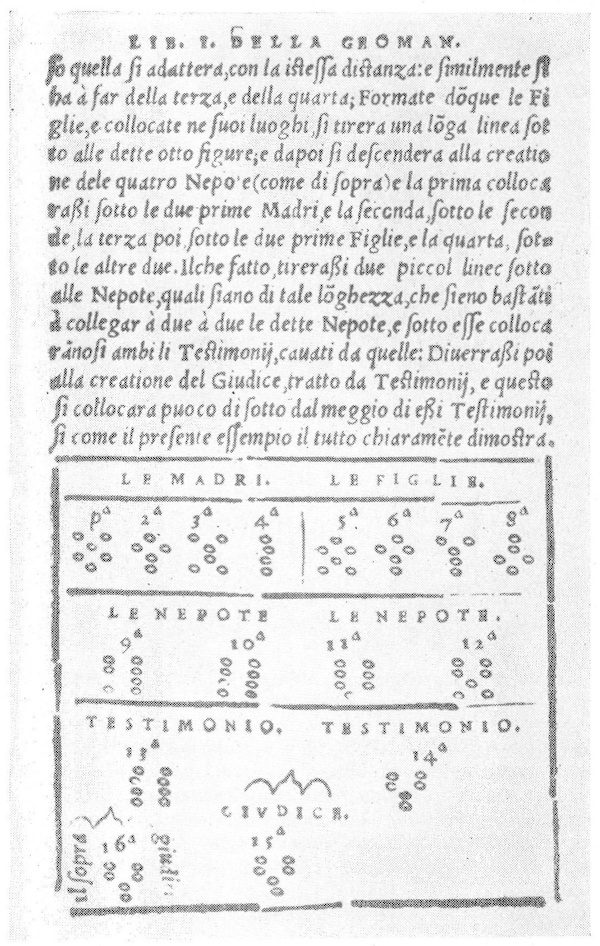
After the calculations, the first twelve figures are assigned to the twelve houses. Each house governs a sphere of life:
- 1 Life (Vita) — destiny, life path, personal strength;
- 2 Estate (Lucrum) — wealth, trade, money, servants;
- 3 Kin (Fratres) — brothers, sisters, neighbors, nearby journeys;
- 4 Ancestors (Parentes) — home, family, parents, real estate;
- 5 Joy (Filii) — children, love, creativity;
- 6 Ailments (Valetudo) — health, minor illnesses, daily chores;
- 7 Union (Uptiae) — marriage, partnership, relationships, alliances;
- 8 Fear (Mors) — crises, death, inheritance, completion;
- 9 Wayfarer (Perigrinationes) — distant roads, faith, wisdom, education;
- 10 Fortune (Honores) — career, glory, authority, recognition;
- 11 Trust (Mici) — friends, patrons, hopes, and dreams;
- 12 Adversary (Inimici) — secret enemies, prison, misfortune.
The figure’s place in a house decides which sphere its meaning concerns. The user’s question belongs to one chosen house; the Witnesses and Judges help interpret the overall outcome.
Although a reading is built in a fraction of a second today, the app uses the same algorithm employed several centuries ago. That is why a modern digital chart still matches the classical Rafli system.